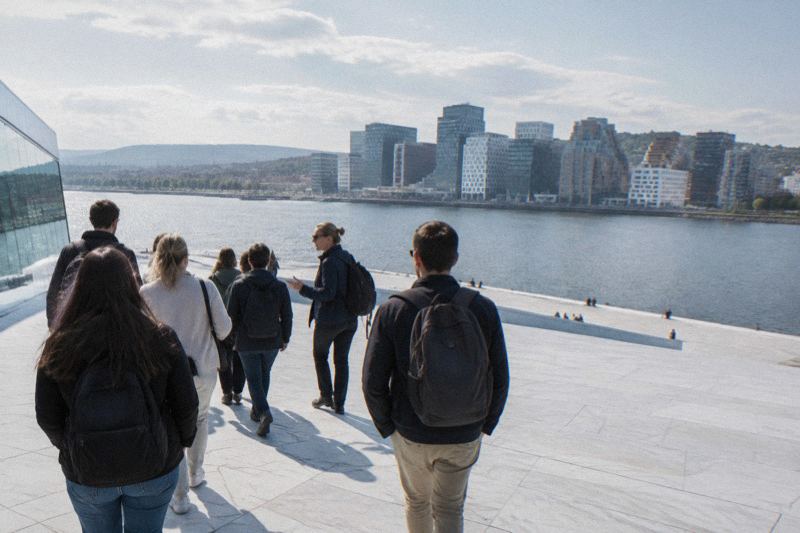
What To See In Oslo In One Day: A Free Walking Itinerary
One day is enough to see Oslo's core on foot, and almost all of it costs nothing: the palace park, the harbour promenade, the fortress grounds and the Opera House roof are all free.
Short answer
Start at Jernbanetorget, walk Karl Johans gate to the Royal Palace park, loop back through Aker Brygge and the free Akershus Fortress grounds, then finish on the Opera House roof at sunset. Every stop on this route is free, and the 2-hour Nordic Freedom Tours walk covers the same centre, rated 4.76 out of 5 across 2,192 GuruWalk reviews.
Oslo's centre is compact in a way few capitals are: the distance from the central station to the Royal Palace park is a twenty-minute walk, the harbour is another fifteen beyond that, and the Opera House sits close enough to the station that you can see one from the other. Almost everything worth seeing in that triangle is free to enter, which is not true of the museums most itineraries push first. This route strings the free sights into one walkable day, and it pairs naturally with a free walking tour, because the best-rated ones follow exactly the same ground.
What To See In Oslo In One Day: The Short Answer
Walk the city spine from east to west in the morning, then the waterfront in the afternoon, and end on the Opera House roof. Concretely: Jernbanetorget, Karl Johans gate, the Royal Palace park, Aker Brygge, the Akershus Fortress grounds, then Bjorvika and the Opera House. Every one of those is free, and the whole loop is under eight kilometres on foot.
That order matters more than it looks. Karl Johans gate, the processional street running from the station up to the Royal Palace, is best in morning light and before the crowds thicken, and the palace park behind the building is a calm green break before the city gets loud. The harbour promenade at Aker Brygge and the fortress grounds sit on the same westward stretch of shoreline, so they chain together without backtracking. Bjorvika and the Opera House are the natural evening finish, because the roof is at its best in low light and the walk back to the station takes ten minutes.
Two of Oslo's signature free sights sit outside this loop, Vigeland Park to the west and the Ekebergparken sculpture hill across the bay, and a single day forces a choice. If sculptures matter more than the fortress, swap the afternoon for a tram out to Vigeland; the outdoor park is free and always open. The trade-offs are laid out in the guide to free places to visit in Oslo, which covers each sight in depth.
For orientation on day one, the free walking tours are hard to beat, and the strongest of them follows this exact centre. The Nordic Freedom Tours walk, rated 4.76 out of 5 across 2,192 GuruWalk reviews, runs two hours in English and Norwegian and meets outside Jernbanetorget station at the bronze Tiger sculpture, the spot where this itinerary also starts.
Morning: Jernbanetorget, Karl Johans Gate And The Royal Palace Park
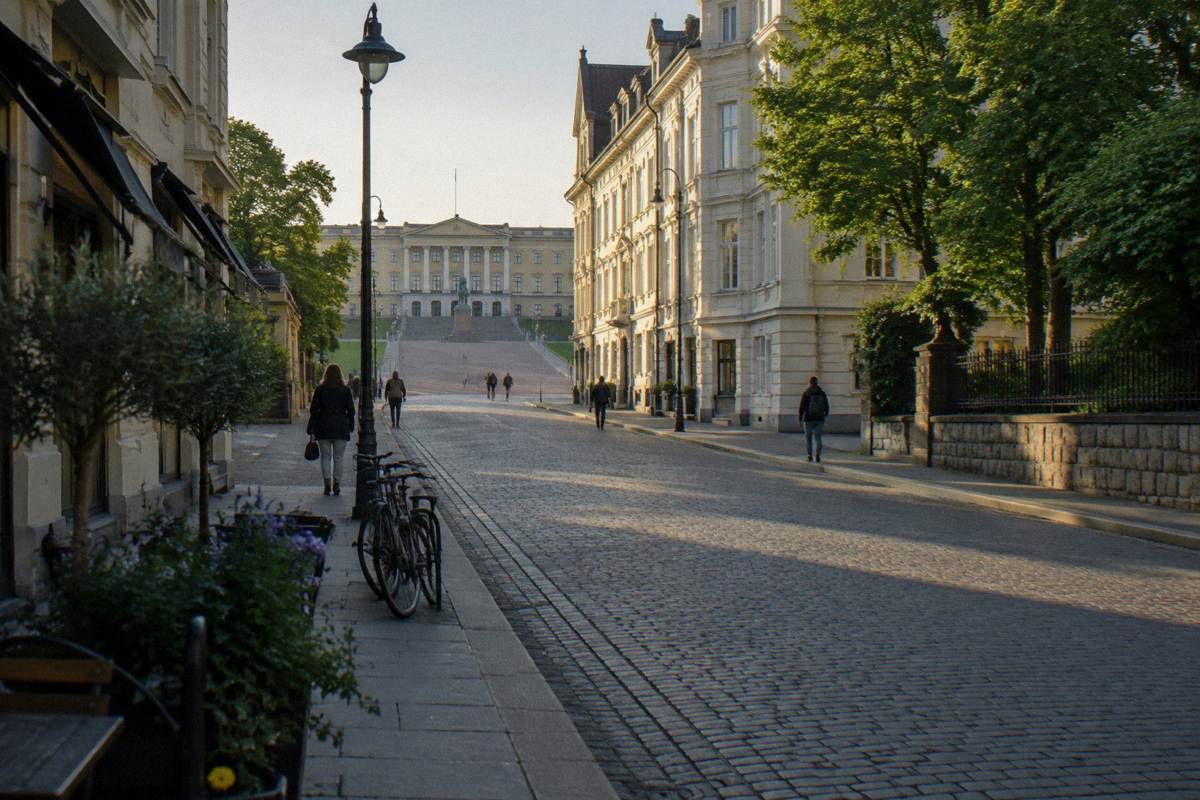
Start at Jernbanetorget by 9am, walk Karl Johans gate west for about one kilometre to the Royal Palace, then circle the palace park behind it. The street itself is free public space, the park is free year-round, and the walk takes roughly an hour unhurried, longer with a coffee stop.
Jernbanetorget is Oslo's zero point: the square in front of the central station, marked by the bronze Tiger sculpture that the Tiger Statue also faces from the station's main entrance. From there, Karl Johans gate runs straight and slightly uphill to the palace, passing the Storting, the national parliament, whose summer tours are free and drop-in only, no advance booking. The National Theatre sits two-thirds of the way up, and its main entrance is a second meeting point used by one of the smaller free walks.
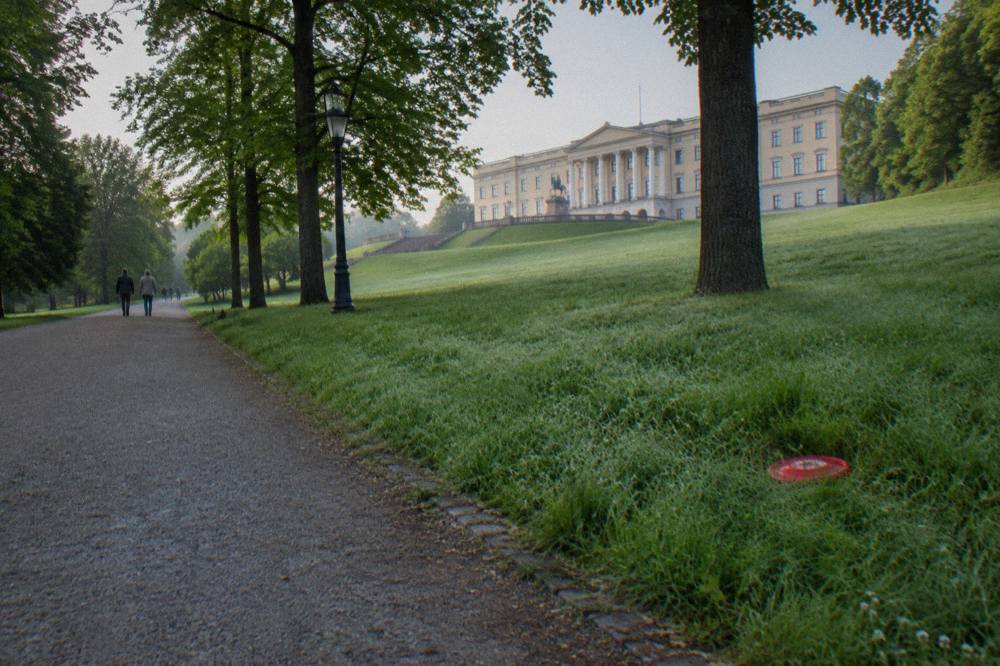
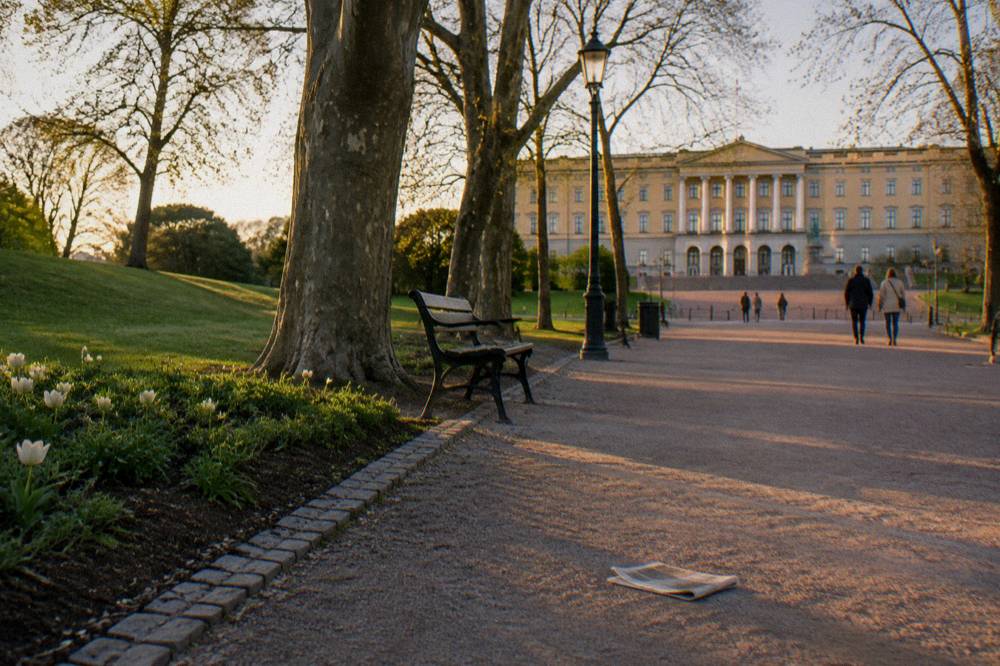
The Royal Palace park is the morning's payoff. The park and grounds are free year-round, open to walk through, with the palace building visible from gravel paths and lawns. The indoor palace tour is a different product entirely: paid, summer-only, and it requires advance booking, so a one-day visit almost always means the park and the facade rather than the interior. The distinction is covered in full in is the Royal Palace free to visit.
This is also the stretch where a free tour earns its tip. The guides who work Karl Johans gate explain the parliament, the theatre and the palace in about two hours, which is time you would otherwise spend reading plaques. The site's hero walk is the natural pick here: the Nordic Freedom Tours 2-hour walk, rated 4.76 out of 5 across 2,192 GuruWalk reviews on GuruWalk, meeting outside Jernbanetorget at the bronze Tiger sculpture, running in English and Norwegian. Reserve a place on the guide's GuruWalk page and pay what you want at the end.
If a two-hour commitment feels long for a one-day visit, there are shorter and differently angled options on the same ground, and the comparison is worth thirty seconds before you commit your morning.
Midday: Aker Brygge, The Harbour Promenade And Akershus Fortress Grounds
From the palace, head south to the water at Aker Brygge, eat on the seaward side of the promenade, then walk the Akershus Fortress grounds that wrap the peninsula's tip. The promenade is free public space, the fortress grounds are free to enter and open to walk, and the whole midday stretch is under two kilometres.
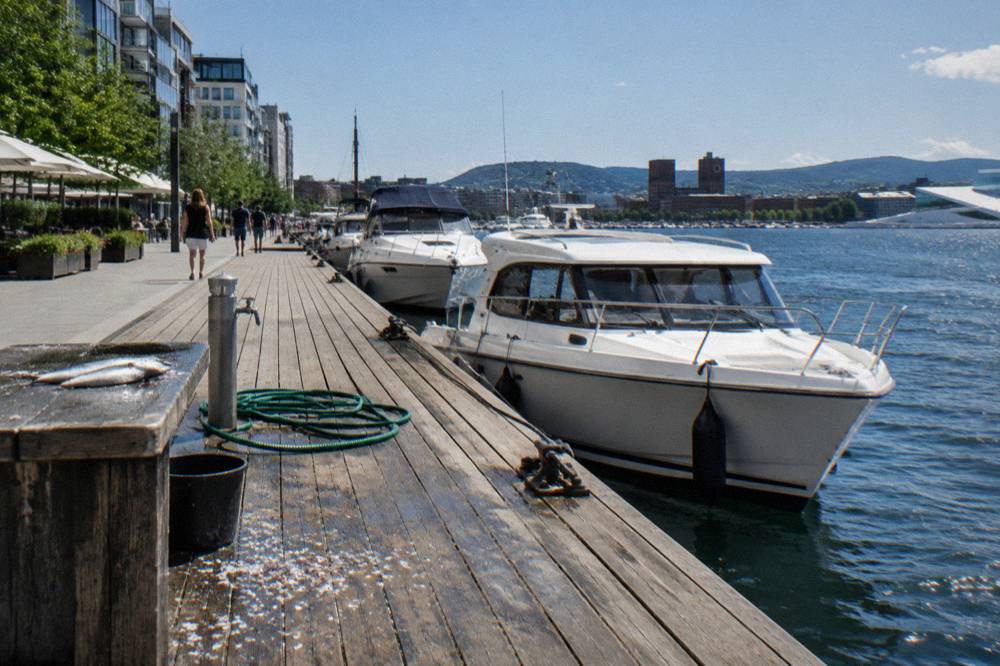
Aker Brygge is the old shipyard turned waterfront, and its promenade is the place Oslo eats outdoors when the weather allows. The restaurants are not budget territory, but the seaward boardwalk is free to walk, and the food halls and harbour baths around Sørenga, a short continuation southeast, give cheaper eating with the same water view. The Nobel Peace Center sits at the harbour's edge here; it is a paid attraction, free only for under-18s and Oslo Pass holders, so a one-day free route walks past it rather than in.
The fortress is the midday anchor. Akershus Fortress grounds are free to enter, a stone-walled headland with views over the fjord, and they chain directly off the Aker Brygge promenade. The trap to know about: the Akershus Castle interior and Norway's Resistance Museum, both inside the same grounds, are each paid, around 160 NOK apiece. The free part is the grounds themselves, the ramparts and the views, and on a one-day pass through the city that is the part that fits. The full breakdown, including what the castle ticket buys, is in what's free at Akershus Fortress.
The fortress walls face the fjord, which is why the grounds work as a lunch stop: benches, water on three sides, and the Opera House visible across the bay, which is where the afternoon is headed. Official visitor information for the fortress complex is maintained by Forsvarsbygg, the Norwegian defence estates agency, at forsvarsbygg.no.
Afternoon: Bjorvika, The Opera House Roof And Deichman
Cross the bay to Bjorvika in the early afternoon, walk up the Opera House roof, then step inside the Deichman library next door. The Opera House roof and public foyer are free with no ticket needed, Deichman Bjørvika is free to use, and both are within five minutes' walk of the fortress grounds' eastern exit.
The Opera House is the sight most visitors remember, and the part they remember is free. The sloping marble roof is a public space: you walk up it from the plaza to the summit, no ticket, no queue, and the foyer inside is equally open. What costs money is a performance, with seats roughly 150 to 990 NOK. A one-day itinerary takes the roof and the foyer and leaves the performance for another trip, and the details are in is the Oslo Opera House free.
Deichman Bjørvika, the city's flagship public library, sits directly across the plaza. It is free to enter and use, five floors of reading rooms and terraces with harbour views from the upper levels, and it is the single best free indoor stop on the route for a rainy afternoon. The building's own information is at operaen.no for the opera side, and the library is run by the city's public library service.
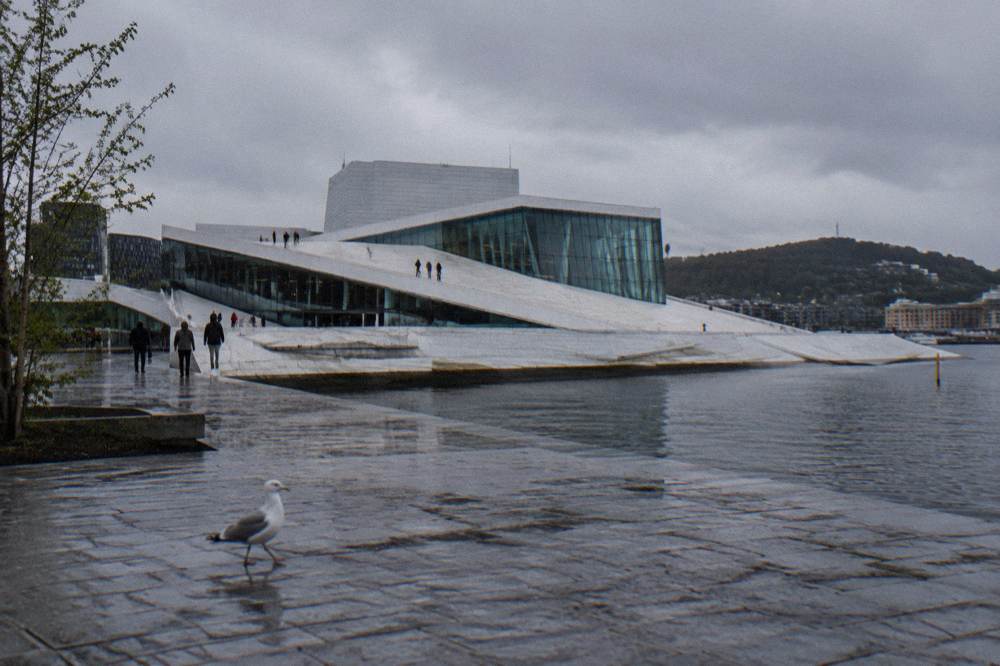
Bjorvika is also the home ground of the Contrasts Walk from LOCAL Walking Tours, a free GuruWalk that starts at the Opera House's main facade and spends two hours on the district's architecture and social contrasts, rated 4.67 out of 5 across 311 GuruWalk reviews, in English and Spanish. If the morning tour covered the historic spine, this is the one that makes sense as a second walk, or as the single walk for visitors who care more about modern Oslo than the palace.
Late Afternoon: Sentrum's Hidden Corners And The National Theatre Quarter
Loop back toward the centre through the streets behind the Storting, where the National Theatre, the university quarter and the small side lanes of Sentrum sit. This stretch is all free public space, it takes about an hour, and it rewards a guide's local knowledge more than any other part of the day.
The centre's back streets are where a generic itinerary runs dry. Sentrum's blocks between Karl Johans gate and the water hold the older commercial lanes, courtyards and small squares that a map does not flag, and this is precisely the ground the local-secrets walk covers: the City Walk with a secrets guide included, rated 4.69 out of 5 across 42 GuruWalk reviews on GuruWalk, two hours in English and Spanish, meeting at the National Theatre's main entrance. The included local secrets guide is the point of this one: it is a take-home document of spots the walk itself does not reach, useful on a short visit. The wider set of guides lives on Free Things To Do In Oslo.
For visitors with no appetite for a second guided walk, the same quarter works self-guided. Oslo Cathedral, near the eastern end of Karl Johans gate, is free to enter during opening hours, and the Damstredet and Telthusbakken streets behind it preserve the wooden-house Oslo that the processional avenue hides. The question of the cathedral's access is answered in is Oslo Cathedral free to enter.
Evening Options: Sunset Spots And The Fjord Islands
Finish the day either on the Opera House roof at sunset, on the Sørenga seaward promenade, or on a ferry to Hovedøya, where the island land is free and the Ruter ferry is a standard transit fare. All three are within reach of the centre, and none of them needs a ticket beyond the ferry's ordinary fare.
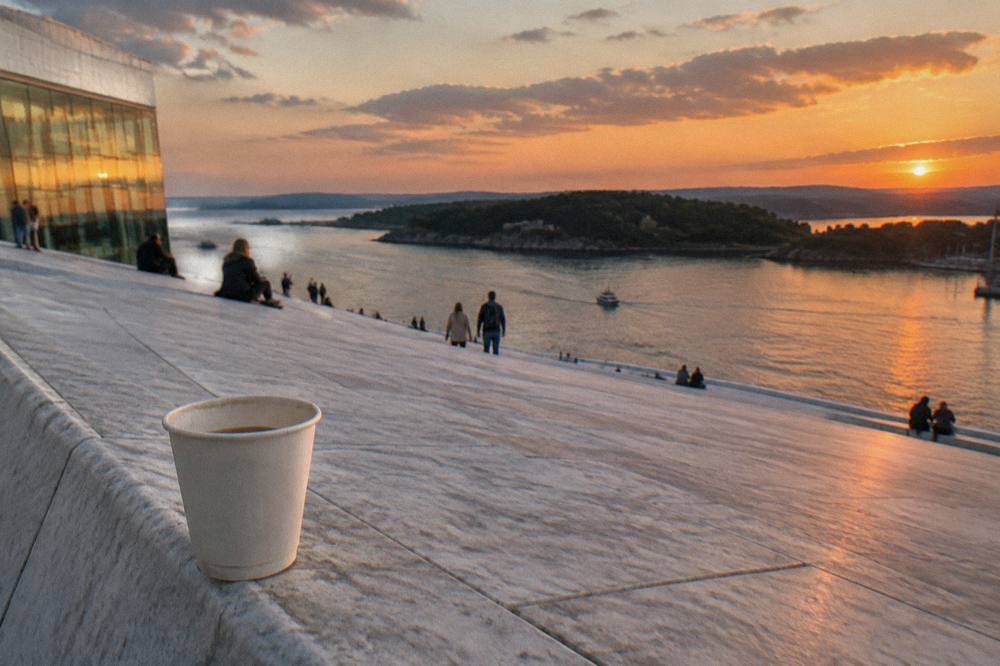
The roof at sunset is the obvious pick, and the obvious pick is correct: the marble faces west over the fjord, and the walk down in fading light ends at the door of the opera foyer. Sørenga, the continuation of the harbour promenade southeast of Bjorvika, is the quieter alternative, with a seaward bath and the fjord islands in view.
The islands are the more ambitious evening. Hovedøya and the other fjord islands are free public land, with ruins, beaches and forest paths, reached by the ordinary Ruter ferry at the standard transit fare, which is never a free crossing even though the island itself costs nothing. On a summer evening with long light, the ferry out and a walk around Hovedøya is the best free hour in the city, and the full logistics are in the fjord islands guide. The ferry system is run by Ruter, the regional transit authority, whose fares and routes are at visitoslo.com, the official tourism site's transit pages.
How Much Does One Day In Oslo Cost?
Done this way, the sightseeing itself costs nothing: every stop on the route is free to enter. The real budget is food, a transit ticket if you skip walking, and the tip on a free tour. A day built on this itinerary can run from the price of a coffee and a tip to well beyond that, depending entirely on how often you sit down.
The honest way to show this is a split between the free core and the paid extras. The table below separates what the route itself costs from the optional add-ons around it, using the verified prices for each paid item.
| Item on the one-day route | Cost | Notes |
|---|---|---|
| Karl Johans gate and Sentrum streets | Free | Public space, no admission |
| Royal Palace park and grounds | Free | Year-round; indoor tour is paid, summer-only, booking required |
| Aker Brygge promenade | Free | Public boardwalk |
| Akershus Fortress grounds | Free | Castle interior and Resistance Museum paid, about 160 NOK each |
| Opera House roof and foyer | Free | Performance tickets roughly 150-990 NOK |
| Deichman Bjørvika library | Free | Free to enter and use |
| Free walking tour | Free, tip at the end | Pay what you want |
| Fjord island ferry | Standard Ruter transit fare | Island land itself is free |
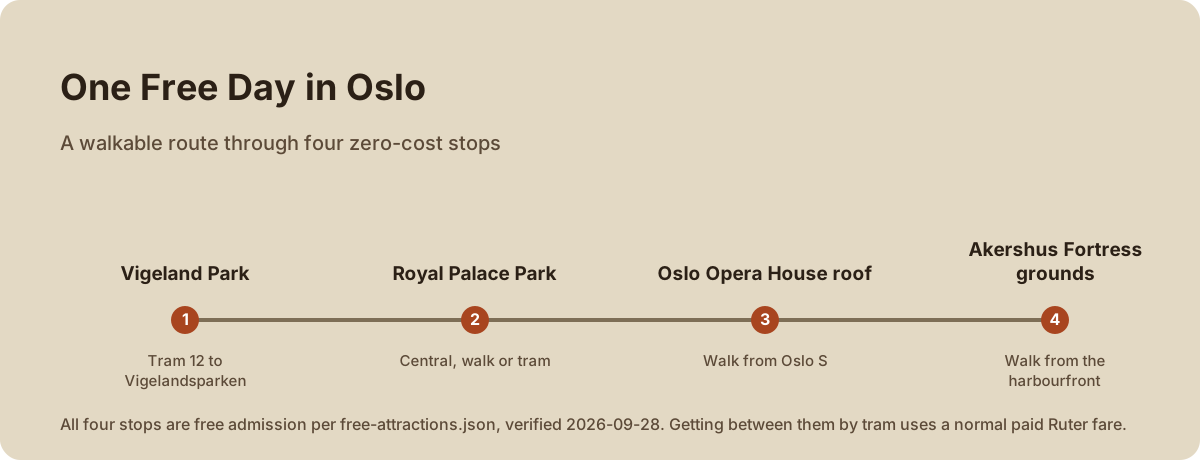
The wider cost picture, including what a typical day in Oslo runs when meals and transit are counted honestly, is broken down in how much does a typical day in Oslo cost and in the budget guide to Oslo on a budget.
Choosing The Right Free Walk For A One-Day Visit
For a single day, the Nordic Freedom Tours 2-hour walk is the strongest fit: the largest review pool on the roster, the same centre as this itinerary, and a meeting point at the route's start. Rated 4.76 out of 5 across 2,192 GuruWalk reviews, it is the walk to book if you only take one.
The alternatives trade coverage for angle. The Short Walk, English Only, rated 9.7 out of 10 across 332 freetour.com reviews, runs an hour and a half from the Tiger Statue in front of the central station, which suits a day where every hour counts. The Perfect Introduction walk, rated 9.1 out of 10 across 191 freetour.com reviews, is the longest at 2 hours 15 minutes and meets near the Royal Palace by the statue of the glove with white umbrella, so it starts where the morning section of this route starts. The comparison below puts them side by side.
| Walk | Platform and rating | Duration | Meets at |
|---|---|---|---|
| Nordic Freedom Tours, 2-Hour Walk | 4.76 out of 5, 2,192 GuruWalk reviews | 2 hours | Outside Jernbanetorget station, at the bronze Tiger sculpture |
| Short Walk, English Only | 9.7 out of 10, 332 freetour.com reviews | 1 hour 30 minutes | Tiger Statue in front of Oslo Central Station |
| Perfect Introduction, Longest Walk | 9.1 out of 10, 191 freetour.com reviews | 2 hours 15 minutes | Near the Royal Palace, statue of the glove with white umbrella |
| Contrasts Walk, Opera District | 4.67 out of 5, 311 GuruWalk reviews | 2 hours | Main facade of the Opera House |
| City Walk, Secrets Guide Included | 4.69 out of 5, 42 GuruWalk reviews | 2 hours | Main entrance of the National Theatre |
Note the two rating scales in that table: GuruWalk figures are out of 5, freetour.com figures are out of 10, and the two are not directly comparable. The deeper question of whether these walks are worth the tip at all is examined in are free walking tours worth it, and the etiquette of that tip in how much to tip for a free walking tour.
One-Day Variations: When The Weather Or The Season Changes The Plan
Rain moves the day indoors to Deichman, the City Hall interior and the Botanical Garden's greenhouses; winter shortens the outdoor loop but opens the palace park in snow; and a museum day replaces the fortress grounds with MUNCH's free first-Wednesday evening if the calendar cooperates. Every variation keeps the core free.
Oslo's weather does not cooperate on command, so the route needs a wet-weather twin. The strongest free indoor stops are Deichman Bjørvika, the City Hall interior, which is free with free drop-in guided tours in summer, and the Botanical Garden at Tøyen, free for all visitors, though the Natural History Museum beside it is paid and its current adult price is not published here. Winter has its own payoff: the palace park and the fortress grounds in snow are the city at its most photogenic, and the Opera House roof stays walkable, with care on the marble.
The seasonal picture, including what winter does to the ferry schedule and the harbour baths, is laid out in Oslo in winter for free, and the one-day question with a shorter daylight budget in what to see in Oslo in a day.
The Route At A Glance
The full day, in order: Jernbanetorget, Karl Johans gate, the Royal Palace park, Aker Brygge, the Akershus Fortress grounds, Bjorvika and the Opera House roof, Deichman, and an optional evening ferry to Hovedøya. Roughly eight kilometres of walking, all of it free to enter, and finishable between 9am and sunset.
| Time | Stop | Cost | What you get |
|---|---|---|---|
| 9:00 | Jernbanetorget and Karl Johans gate | Free | The city spine, parliament, National Theatre |
| 10:30 | Royal Palace park | Free | Grounds and facade, free year-round |
| 12:00 | Aker Brygge promenade | Free | Harbour walk and lunch stop |
| 13:30 | Akershus Fortress grounds | Free | Ramparts and fjord views |
| 15:00 | Opera House roof and foyer | Free | The signature walk-up view |
| 16:00 | Deichman Bjørvika | Free | Reading rooms and harbour terraces |
| 17:30 | Opera roof at sunset, or ferry to Hovedøya | Free, ferry fare applies | The closing view |
One practical note on timing: the free walks start at fixed meeting points, so if you take the Nordic Freedom Tours walk at the start of the day, the rest of the route shifts an hour later and the evening options compress. Booking the walk for the morning and the roof for sunset is the pairing that works most days.
If one day turns into two, the second day belongs to Vigeland Park, the outdoor sculpture park that is free and always open, with the Vigeland Museum beside it paid, or to the Ekebergparken sculpture hill across the bay. Those extensions, and the question of how Vigeland's free and paid halves split, are in Vigeland Park: free, but not the whole story.
For the day itself, the three walks below are the ones that map onto this route: the hero walk for the centre, the short walk for tight schedules, and the longest introduction for the full spine.
Common Questions About One Day In Oslo
Is One Day Enough To See Oslo?
The free core of Oslo, the palace park, the harbour, the fortress grounds and the Opera House roof, fits comfortably into one day on foot. What one day cannot absorb is the museum peninsula at Bygdøy, where every museum is paid, or the fjord islands at leisure. One day covers the centre well and leaves the rest for a return trip.
What Is the Best Free Thing To Do In Oslo In One Day?
The Opera House roof is the single most distinctive free experience in the city, a walkable marble slope with fjord views and no ticket. Close behind are the Akershus Fortress grounds and the Royal Palace park. A free walking tour ties them together, and the Nordic Freedom Tours walk, rated 4.76 out of 5 across 2,192 GuruWalk reviews, covers the centre in two hours.
Can You Walk Everywhere In Oslo In One Day?
The core route is under eight kilometres end to end, so yes, the free sights in the centre are entirely walkable in a day. The exceptions that need transit are Vigeland Park to the west and the fjord islands, which need the Ruter ferry at a standard transit fare. The tram network covers the western extensions if the legs give out.
Do You Need Money For A Free Walking Tour?
No payment is taken up front on any walk on this site's roster. Each is free or pay what you want, with the tip handed to the guide at the end in cash or by app, at whatever level the walk earned. The etiquette and typical amounts are covered in the tipping guide.
Is the Oslo Opera House Roof Really Free?
Yes. The sloping roof and the public foyer are free to access with no ticket, during the building's opening hours. Only performances are paid, with seats roughly 150 to 990 NOK. The roof is the finish most one-day itineraries should aim for, especially at sunset.
What Should I Not Miss In Oslo If I Only Have One Day?
The Karl Johan spine, the Royal Palace park, the fortress grounds and the Opera House roof. If one thing must be cut, cut Aker Brygge's restaurant row and keep the promenade walk; if one thing must be added, add the evening ferry to Hovedøya in summer, where the island land is free and only the crossing is a transit fare. The fuller answer is in what should I not miss in Oslo.